

















AI SOC platforms that investigate EDR alerts include Prophet Security, CrowdStrike Charlotte AI, SentinelOne Purple AI, Microsoft Security Copilot in Defender, and Palo Alto Networks Cortex XSIAM.
For many buyers, Endpoint Detection and Response (EDR) alerts are the priority. The problem is that many AI SOC platforms define “end-to-end EDR alert investigation” differently. Some summarize an alert inside a single console, while others deliver a finished investigation across endpoint, network, and identity. This article compares five platforms on one standard and tests each against a ClickFix intrusion..
Which Five Platforms Investigate EDR Alerts End to End?
Each entry describes how one of these AI alert triage tools handles an EDR alert, and which teams it suits.
Prophet Security
Prophet Security, a leading agentic AI SOC platform recognized in Rising in Cyber 2026, investigates every EDR alert at the same depth whatever its severity, connecting a registry write, a hidden interpreter, and a newly registered domain into one evidence-backed determination. Response runs through Agent Actions, with human approval wherever the team requires it.
Best for: Teams that want low-severity EDR alerts investigated as thoroughly as critical ones.
CrowdStrike Charlotte AI
CrowdStrike’s Charlotte AI Detection Triage Agent classifies new Falcon detections as true or false positives, recommends whether to close or escalate, and documents its reasoning. The Response Agent then guides the investigation across Falcon data. Both start from first-party Falcon detections.
Best for: Teams standardized on Falcon that want first-pass triage on Falcon detections.
SentinelOne Purple AI
SentinelOne’s Purple AI Auto-Triage feature estimates how likely each alert is a true positive. An Auto-Investigation then works the alert and returns a verdict with a written justification, across native and third-party data in the Singularity platform.
Best for: SentinelOne customers who want an alert-to-verdict workflow with the reasoning attached.
Microsoft Security Copilot in Defender
Security Copilot is the AI assistant in Microsoft’s Defender offering. It summarizes an incident, covering up to 100 alerts, when an analyst opens it. It then recommends steps for triage, containment, investigation, and remediation inside Defender XDR.
Rather than working on single alerts, it works on full incidents, and guided responses cover incident types such as phishing, business email compromise, and ransomware.
Best for: Defender XDR teams that want summaries and recommended next steps in the portal analysts already use.
Palo Alto Networks Cortex XSIAM
In Cortex XSIAM, case grouping consolidates related issues, assets, and artifacts into one case. AI then works the case as a whole inside Palo Alto’s data platform.
Best for: Teams consolidating SIEM, EDR, and automation on Palo Alto’s platform.
What Does “End to End” Need to Include?
The list above shows how each vendor describes end-to-end investigation of EDR alerts. To compare them on equal terms, this article applies a standard definition. An end-to-end investigation of EDR alerts should do five things:
- Group alerts on one host into one investigation
- Pull the network evidence first, because lure domains and payload hosts often go offline within days
- Check the context that explains benign activity, such as a ticketed remote-support session
- Reach a verdict with the evidence attached
- Take the containment step, or propose it for approval
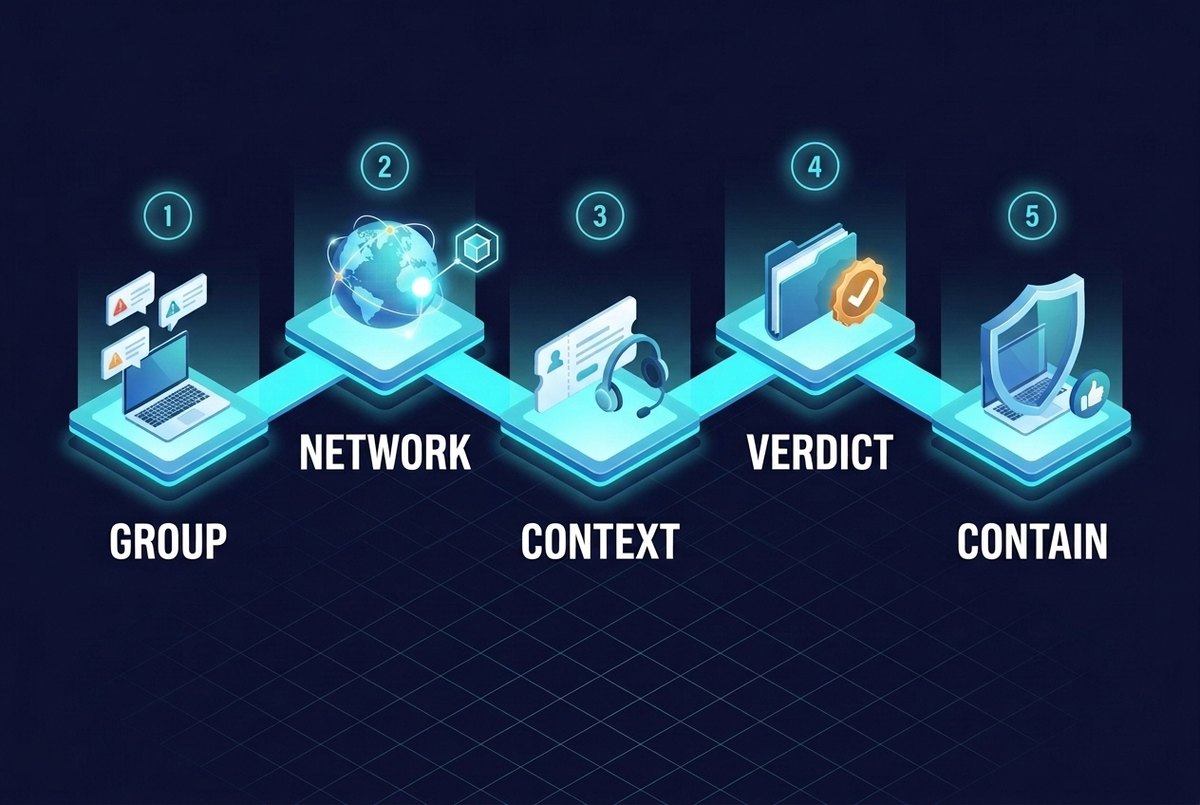
Ask each platform where it stops. Some stop at a summary, while others carry the work through to a verdict and a response step. The second kind gives analysts a verdict and evidence to review, and containment can wait for their approval where the team requires it.
How Does ClickFix Test an AI SOC Platform?
How a platform handles ClickFix shows how effectively it runs end-to-end EDR alert investigations.
ClickFix is a social engineering attack vector where threat actors trick users into manually copying and executing malicious commands on their own devices (cataloged by MITRE as Malicious Copy and Paste). It’s relevant because ESET’s H1 2026 Threat Report found ClickFix detections grew by 108% between H2 2025 and H1 2026.
On the endpoint, a ClickFix infection typically leaves four events:
- A registry write
- A hidden interpreter, such as PowerShell running with no visible window
- A connection to a newly registered domain
- A new persistence file that keeps the malware running after a reboot
Each can look routine on its own, so a queue that closes alerts one at a time misses the wider context and, hence, the intrusion. A queue that groups them by host can see the sequence.
Prophet Security’s AI SOC Analyst, for example, takes the latter approach, grouping related investigations into one case and ending with an evidence-backed determination that shows every query. That approach lets it investigate a ClickFix attack as one sequence instead of four closed alerts.
Doesn’t Detection Tuning Remove the Need for Investigations?
No, because even perfectly tuned detection rules will miss behavior that looks normal, but is actually malicious. The ClickFix example shows why.
ReversingLabs ran a YARA rule built around one ClickFix campaign pattern across its file collection and matched 283 samples. More than 60% had no antivirus detection when analyzed. The infrastructure behind these lures changes constantly, so an investigation has to establish what ran on the host.
Real software can be abused, too. In October, Siemens confirmed that attackers behind the Romulus ClickFix campaign paired a genuine, signed copy of Siemens Software Center with malicious DLLs (CVE-2026-110936). The Siemens program itself was real and untouched, and the attackers’ files ran alongside it to borrow its trust.
A rule can tell you a command was pasted, or that a file is signed. Whether it is an attack takes an investigation, which checks where the program was run from, what files are next to it, and what it connects to.
Can the Platform Tell Real IT Support From a ClickFix Attack?
Some ClickFix attacks install a remote-support tool, so the attacker looks like IT staff. Microsoft, for example, documented ClickFix delivering ScreenConnect, a legitimate remote-management tool. An active remote-support session proves nothing on its own, so a real help desk call and an intrusion can look the same on the endpoint until someone checks for a ticket.
So, ask each platform two questions:
- Does it check for a sanctioned, ticketed session?
- Does it check the reputation of the URL the command fetched?
The answer to both of these questions should be an emphatic yes.
Does Severity Change How Deep the Investigation Goes?
It can. ClickFix infrastructure often rotates within days, while endpoint artifacts stay. A platform that investigates low-severity EDR alerts as they arrive, at the same depth as critical ones, keeps the network trail while it still exists. A platform that waits for severity to climb may open the case after the domain is gone. Prophet Security’s AI Threat Hunter can also sweep for the same artifacts on hosts where no alert fired.
What Should You Ask Each Platform to Do?
Everything above comes down to a single test you can run on your own queue.
Pull 30 days of low-severity EDR alerts and group them by host. Pick one cluster and ask each shortlisted platform to investigate it end to end. Note which platforms return a verdict with the evidence attached, and which return a summary. That difference shows how far each platform carries an EDR investigation.