



















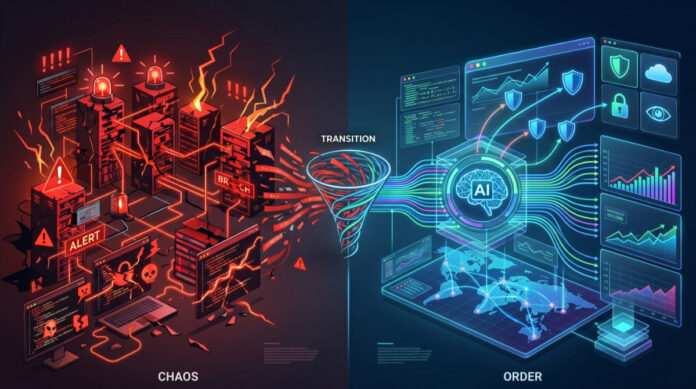
Security leaders are being asked a very different question than they were five years ago. Not “Are we secure?” But “Where will we be vulnerable next?”
This is a significant change. It shifts cybersecurity from purely defensive to more preemptive, requiring the ability to anticipate future risks before they happen. This is the point at which AI-driven cybersecurity, predictive risk models, and Continuous Threat Exposure Management (CTEM) begin to converge.
The problem is that most security programs are not built for that future.
Why reactive risk management no longer works
Traditional security programs still optimize for response. Teams investigate alerts, respond to incidents, and patch vulnerabilities as they crop up. While this model is necessary, it assumes that risk is something you discover only after it begins to take shape.
This is an unrealistic expectation.
Reactive security leads to three structural problems:
- No foresight: Groups know why things have failed, but not why they may fail again in the future
- Lack of consistent context: Risks are assessed separately for clouds, identities, and endpoint environments
- Unproportionate emphasis: Quantity sparks reaction, rather than significance
The outcome is unsurprising. While security teams sort through thousands of results, the underlying issues that cause vulnerabilities remain unaddressed. This is why so many companies are turning to threat exposure management to achieve context-based risk awareness.
What is threat exposure management, and why does it matter?
Threat exposure management is about continuously pinpointing, analyzing, and limiting the conditions bad actors can exploit to get their hands on critical assets. It stretches the definition of risk beyond individual vulnerabilities to include misconfigurations, identity and access flaws, cloud exposures, and interconnected attack paths
This is important since malefactors don’t work in siloes. They build chains out of weakness, crossing identities, systems, and environments until they reach a point of value.
The question that needs to be answered is different because of this dynamic. It is not “what vulnerabilities are there?”, but rather “which combination of elements could lead to a breach?”
CTEM as the foundation for preemptive security
CTEM is the basis upon which the transition from responsive to preemptive security can be made. Instead of seeing risks on a regular basis, CTEM forms a constant cycle of visibility, analysis, and prioritization.
For instance, security professionals are able to have an updated view of their exposure and vulnerabilities. By joining the dots between risks across different environments, they can gain insight into how attacks work.
This continuous model enables teams to answer three essential questions:
- What assets do we operate?
- Where are we exposed?
- What actions will reduce the most risk?
Without this level of consistency and context, risk forecasting lacks the data quality required to be reliable.
How AI transforms cyber risk forecasting
The addition of AI into this framework creates a significant new capability: prediction.
Using exposure data collected over an extended period of time, AI can detect trends and connections that are hard for people to spot. It monitors the evolution of exposure risks, forecasts potential attack pathways, and identifies where the risk will be concentrated. This makes it possible to go beyond reactive analysis and embrace proactive risk modeling.
Practically, this means a shift in approach. Rather than responding to warnings, teams will work on Preempting the exposure clusters with the highest risk of being exploited, and prioritizing the remediation of vulnerabilities based on likelihood of an attack. They can also dedicate time to coordinating security activities based on business consequences, instead of working reactively.
This is the difference between reacting to incidents and changing outcomes before incidents happen.
From technical risk to business-aligned security
One of the hardest issues to tackle in cybersecurity is translation. Technical indicators do not necessarily translate into business impact, making it hard to properly prioritize.
Vulnerability scores do not indicate whether revenue is threatened, whether business operations can be hampered, or whether regulations will be violated. Without that knowledge, the prioritization process relies on guesses.
However, AI-driven models make up for this. By connecting technical exposures to the business criticalities and by modeling out attack paths, they translate technical risks into business risks. Security professionals then know what needs to be protected.
The process of prioritization thus no longer consists of addressing the highest severity problem but in reducing the greatest risk.
Using AI to anticipate threat exposure
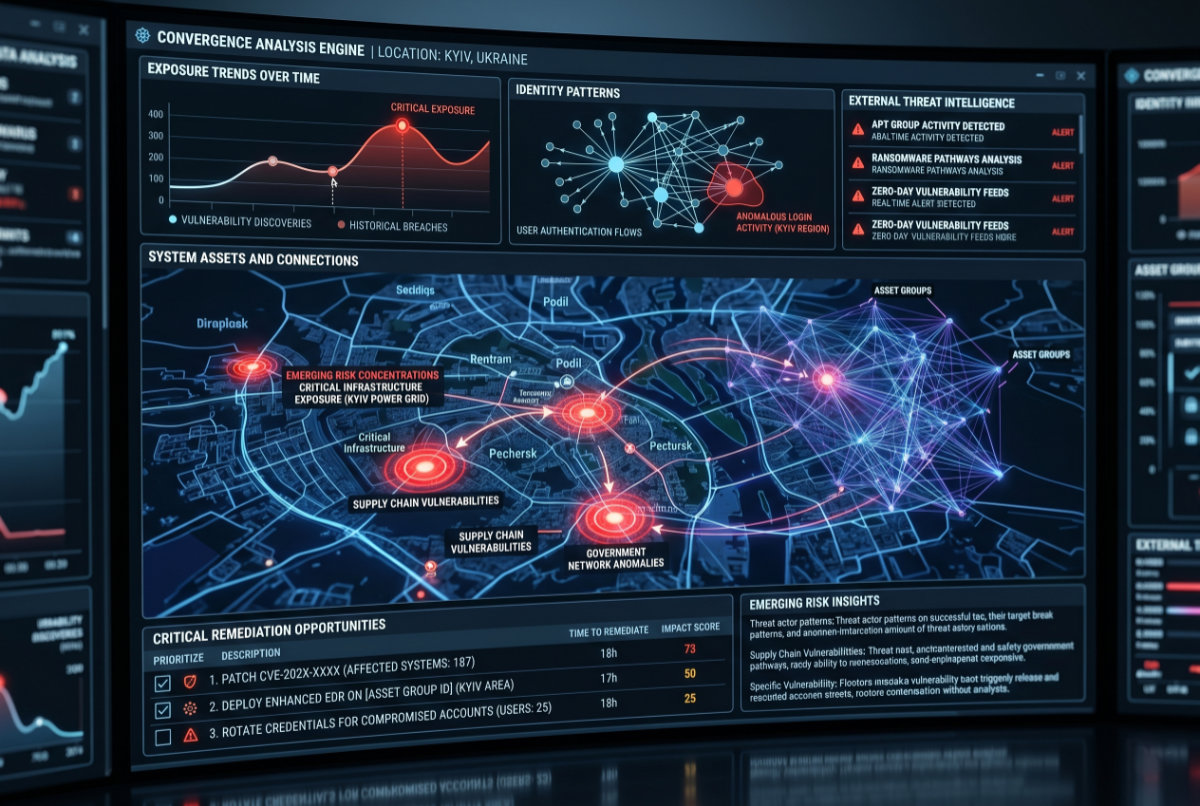
AI does not predict specific attacks with certainty, but it does identify the conditions in which attacks are most likely to succeed. That distinction is important. The goal is not to forecast exact events, but to reduce the probability that those events will occur.
To do this, AI models analyze a combination of signals, including exposure trends over time, changes in the attack surface, identity and privilege patterns, and external threat intelligence
By bringing these elements together, they surface emerging risk concentrations and highlight the most critical remediation opportunities. This is where preventive security becomes operational rather than aspirational.
From data to executive-level insight
Data is certainly not an issue for security professionals. What they may be lacking is their ability to turn this data into actionable insights.
By taking an exposure-based approach to predictions, we can change that situation and provide risk scaenarios, impact projections and prioritized actions aligned to business objectives
This means that CISOs are able to focus not only on reporting activities but on proving risk reduction.
For instance, they no longer need to report on vulnerability counts but will be able to prove that system exposure has lowered over time, that risk to important business processes has been minimized, and where future investments should be made.
Aligning cyber risk with business priorities
Not only does an established security strategy go beyond identifying risks, but it also connects those risks to business goals. This can be done by relating risk to business services, knowing the interdependencies among systems, and assessing the consequences of the identified risks.
When there is such alignment, CISOs can respond to the key concerns of their boards:
- What risk threatens revenue?
- What risk threatens uptime?
- What risk threatens compliance?
These are the questions that define effective risk forecasting.
The future: preemptive, not reactive
Security will become a state characterized by continuous observation, analytics enabled by AI, and proactive decision-making. Even though this new strategy doesn’t eliminate the process of detection and reaction, it emphasizes other aspects.
As far as CISOs are concerned, this is a paradigm shift from reacting to security threats to becoming leaders in terms of managing risks. The goal here goes beyond reacting to issues – it involves minimizing them.
Security as a forecasting discipline
A new era is dawning in cybersecurity. It is a time characterized not by even more security tools or alert notifications, but by increased foresight.
The organizations that thrive in the coming years will not just act faster than their counterparts. They will be able to understand what they are exposed to at all times, predict where risks will arise, and take action before the threats can.